When You Leave, They Panic. The Step-by-Step Calm Departure Ladder That Teaches Your Dog to Feel Safe Home Alone — So You Can Walk Out the Door Without Guilt, Dread, or One More Angry Note From the Neighbours.
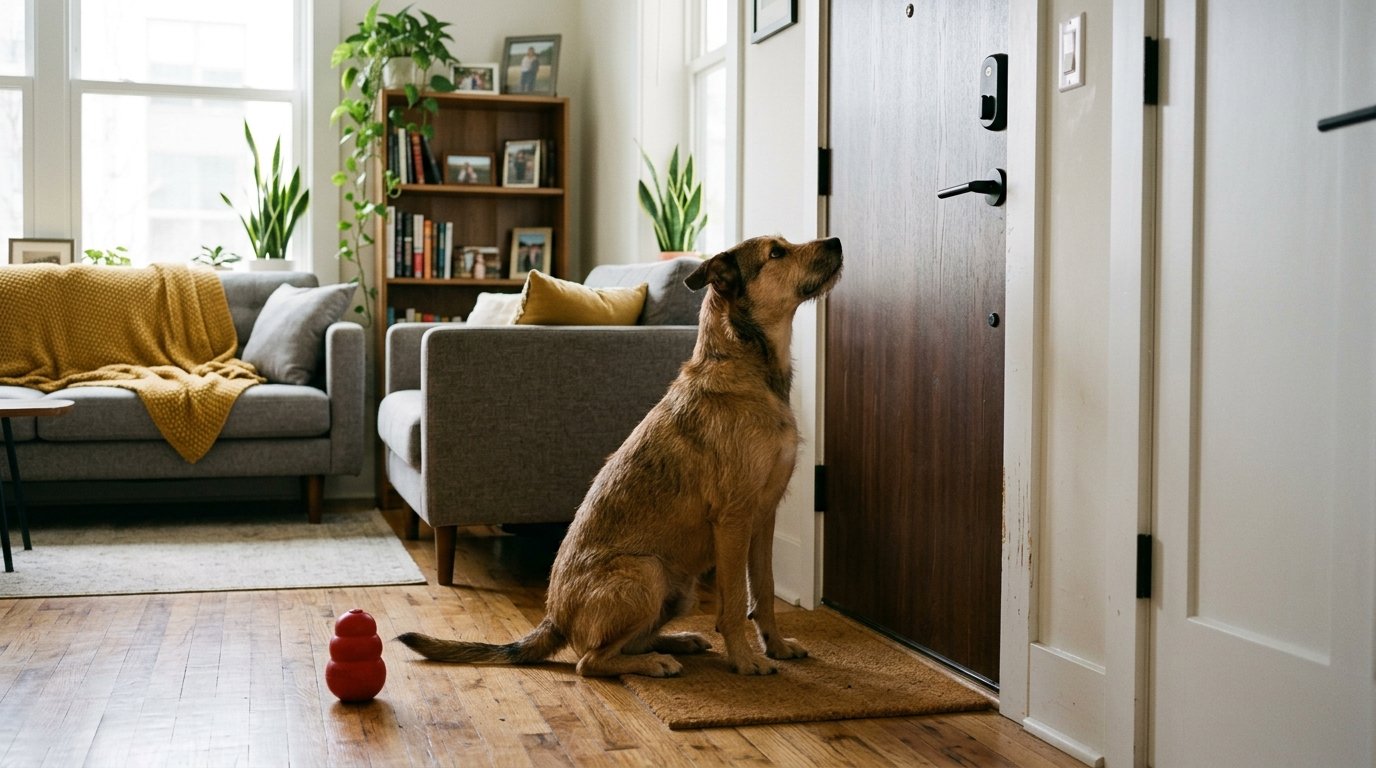
You know the exact moment it starts.
The keys.
You haven't even touched them yet. You walked toward the counter where they sit and your dog's head lifted from the couch. By the time your fingers close around the keyring, he's pacing. By the time the keys jingle, he's at your feet. By the time you reach the door, he's whining. And by the time the door closes behind you, the howling has started and you're standing in the hallway with your forehead against the wall wondering what you're doing to this animal.
You know what happens next because you've watched it on the camera. Forty minutes of crying at the door. Then the pacing. Then the chewing. The doorframe. The blinds. The corner of the couch. Then he lies by the door, head on his paws, staring at the handle, waiting.
You know this because you check the camera from your desk at work. You check it at 9:15am. You check it at 10:30. You check it at lunch. Every check is a small devastation: he's still at the door. He's still crying. He's still waiting for the sound of your keys on the other side.
You have restructured your entire life around the keys. You don't pick them up until the last possible second. You've learned to slide them silently into your bag without jingling. You've started putting your shoes on in the bathroom so he can't see them. You leave the TV on. You scatter treats that go untouched. You have developed an entire departure choreography designed to minimise the panic, and none of it works because the panic isn't about the keys. The keys are just the signal. The panic is about the door closing. The panic is about being alone. And no amount of silent key-handling fixes that.
If the keys start the pacing, if the camera shows 40 minutes of crying every time you leave, if the neighbor notes are accumulating, if the calming chews did nothing, if the crate made it worse, if the trainer quoted you a number you can't afford, keep reading.
My name is Sarah. I'm 32. I live in Austin. I have a 3-year-old rescue mix named Cooper.
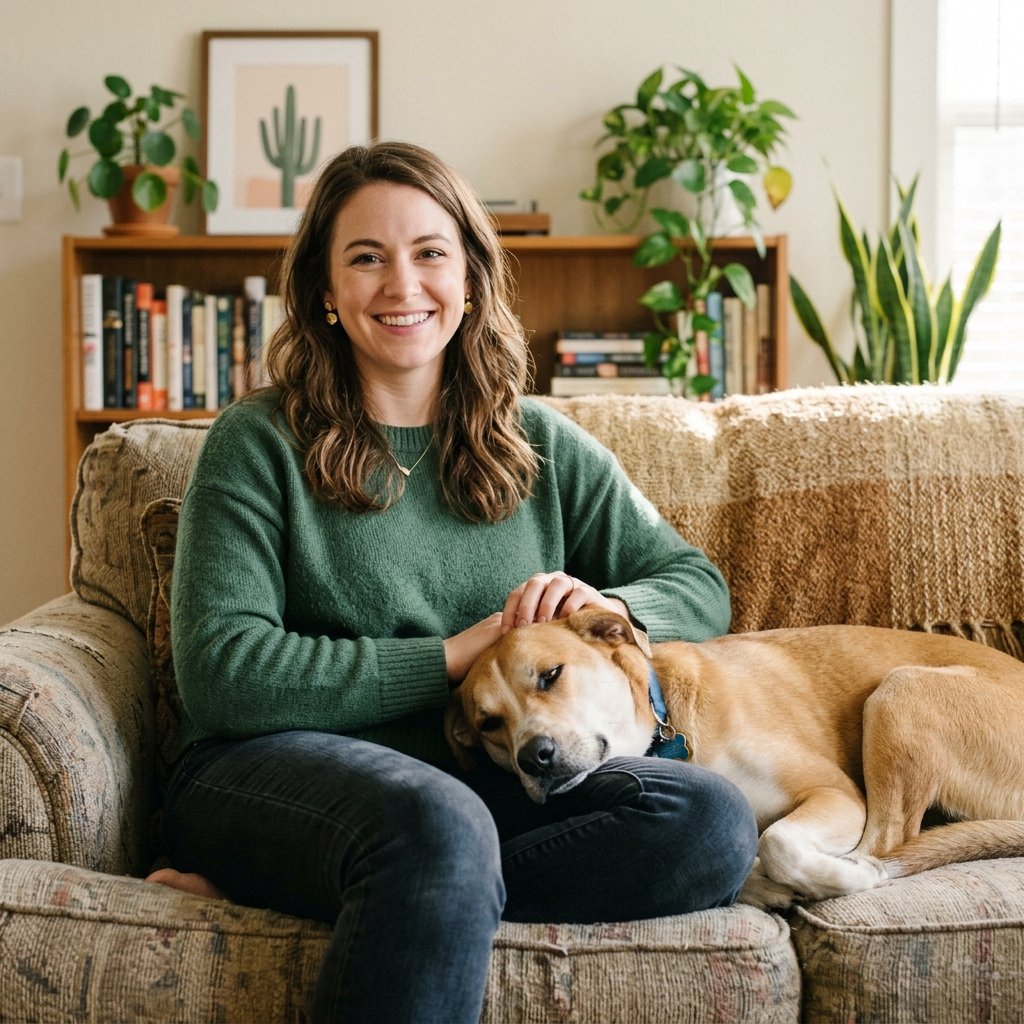
And for 14 months, the keys were the trigger that started the panic that was destroying my apartment, my social life, and my relationship with the dog I adopted because I wanted a companion, not a hostage situation. Until I found the protocol that every $200/hour separation anxiety trainer uses — and that nobody had told me existed in a format I could follow myself.
The Night I Tried the Crate
Everyone said crate train him. "Dogs are den animals. They feel safe in enclosed spaces." I bought a $50 wire crate. Put his blanket inside. Put treats inside. Left the door open for three days so he could get used to it.
Day 4, I closed the crate door and left for 30 minutes.
When I came back, Cooper had pushed his paw through the bars trying to get out. The paw was bleeding. Not badly. But bleeding. He was shaking. The blanket was soaked with drool. He had urinated inside the crate — a dog who hasn't had an accident since puppyhood.
I opened the crate door. He pushed past me and went to the corner of the apartment and lay there, shaking, not looking at me.
I sat on the kitchen floor next to a bloody crate and understood three things at once: my dog is not being "bad." He is panicking. This is not a training problem. This is a fear problem. And the crate — the thing everyone told me to try — had made the fear worse. I had just locked my terrified dog in a cage and left.
I cried on the kitchen floor. Not a little. A lot. Because I adopted this dog to give him a good life, and instead I had locked him in a cage where he bloodied himself trying to escape, and the only reason he was panicking was because I used to be home all the time and now I'm not, and that is entirely, completely, unambiguously my fault.
The crate went to Goodwill the next morning. I will never crate-train a panicking dog again. And I will never forgive the people who told me to "just crate him" without asking whether his anxiety was containment-safe first.
$400 and Five Failures
Adaptil calming pheromone diffuser. $60. Plugged it in near his bed. Left it running for 6 weeks. Adaptil releases a synthetic version of the pheromone nursing mothers produce to calm puppies. The research shows modest effects on general anxiety. Cooper's separation anxiety is not general anxiety. It is a specific panic response triggered by departure cues. The diffuser had no measurable effect on his departure behavior. He howled at the door the same way with or without synthetic pheromones in the room.
Calming chews. $35/month. An Instagram ad. "Veterinarian-formulated calming supplement." L-theanine, chamomile, hemp extract. I gave them 30 minutes before leaving as directed. For 3 months. $105 total. Cooper chewed the doorframe with the same enthusiasm he chewed the calming treat. The chews reduced precisely nothing, which makes sense in retrospect: you cannot supplement your way out of a conditioned panic response. The panic is learned behavior, not a nutritional deficiency.
The crate. $50. Covered above. Bloodied paw. Soaked blanket. A shaking dog who wouldn't look at me. Made everything worse. $50 I will regret spending for the rest of Cooper's life.
Kong with peanut butter. $15. Frozen, stuffed, left on the floor before departure. Cooper did not touch it until I returned. I didn't know at the time, but this is a textbook panic indicator: a dog who ignores high-value food when alone is not "being stubborn." He is too panicked to eat. His sympathetic nervous system is in full fight-or-flight. The digestive system shuts down during panic. The untouched Kong wasn't a failure of the Kong. It was my dog screaming "I am too scared to eat" in the only language he has.
"Just let him cry it out." One week. Free advice. From the internet. From my coworker. "He'll learn." He did not learn. The howling escalated from 40 minutes to 90 minutes over the week. The doorframe damage got worse. The neighbor notes went from one to two. "Crying it out" is extinction-based — it works for mild distress, not clinical-level panic. Letting a panicking dog cry it out is like telling someone having a panic attack to "just relax." The fear deepens. The association strengthens. Every departure without resolution teaches the dog that being alone IS as terrifying as he thought it was.
Total: $400+ on products and methods that did not work. Not because I'm gullible. Because none of them addressed the actual mechanism: Cooper's panic is a conditioned emotional response to departure cues (keys, shoes, bag, jacket, door). The only thing that resolves a conditioned emotional response is systematic desensitization — gradually changing the emotional association through structured, sub-threshold exposure. Every product I bought treated the symptom (the anxiety) without addressing the conditioning (the learned association between departure cues and panic).
The $3,600 I Couldn't Afford
I called three trainers. The first two said they "don't take separation anxiety cases." The third — a certified separation anxiety specialist — took a 20-minute phone consultation and quoted me: $725 per month, five-week waiting list, plan for four to six months of sessions.
I opened my Notes app and did the math. $725 x 5 months = $3,625. I have approximately $6,000 in savings. Austin rent is $1,450. After rent and the training, I would have approximately $925 for five months of everything else.
I closed the Notes app. Stared at the wall. And understood: the "real" solution — the one that actually works, the systematic desensitization protocol that certified trainers use — exists. It's proven. It works. And it's priced so that I can't access it.
But here's the thing nobody tells you: the protocol itself is not complicated. What the $725/month pays for is not secret knowledge. It pays for someone to tell you exactly what to do, in what order, for how long, and to adjust the plan when you hit setbacks. The protocol — the Calm Departure Ladder — is a structured sequence of graduated absences that any committed owner can follow. The knowledge isn't $3,600. The hand-holding is $3,600.
What I Found at 1:14am on a Tuesday
That Reddit thread. The one I found through tears at 1:14am. Buried in the comments, someone had described the exact protocol their separation anxiety trainer had used. Step by step. They'd paid the $3,600 and were sharing what they'd learned.
The protocol has a name in the veterinary behavior world: systematic desensitization to departure cues and graduated absences. It's the gold standard for canine separation anxiety. It's what every certified separation anxiety trainer uses. And it works — not through pheromones, not through supplements, not through crating, not through extinction ("crying it out") — but through systematically changing the dog's emotional response to being alone.
The protocol works in three phases:
Phase 1: Departure Cue Desensitization. Your dog panics before you leave because he's learned that specific cues predict departure: picking up keys, putting on shoes, grabbing your bag, putting on your jacket. Each of these cues has been paired with "you're about to be alone" hundreds of times. The first phase breaks this association by repeatedly performing the cues WITHOUT leaving. Pick up keys, sit on the couch. Put on shoes, watch TV. Grab the bag, put it down. Over days, the cues lose their predictive power. The keys stop meaning "alone." They become meaningless background noise.
Phase 2: Graduated Absences. Once the departure cues are neutralized, you begin very short absences. Not 30 minutes. Not even 5 minutes. You start at the duration your dog can handle without panicking — for many dogs, this is literally 2 seconds behind a closed door. Then you increase gradually. 2 seconds becomes 5 seconds. 5 becomes 10. 10 becomes 30 seconds. 30 seconds becomes a minute. Each step stays below the panic threshold. The dog learns: the door closes, the door opens, nothing bad happened. Slowly, the association between "alone" and "panic" is replaced with "alone" and "fine."
Phase 3: Duration Building. Once the dog can handle 10-15 minutes of absence without panic, the increases accelerate. 15 minutes becomes 30. 30 becomes an hour. An hour becomes two. The emotional resilience compounds. Each successful absence builds on the last. Most dogs who complete the full protocol can handle 4-6 hours within 4-6 weeks of consistent practice.
I started the protocol the next morning. Using the Reddit comment, a veterinary behavior textbook I bought for $28, and three YouTube videos from certified separation anxiety trainers. I pieced together a plan.
Days 1-4: Two Seconds Behind a Closed Door
Day 1: I picked up my keys 15 times and sat on the couch. Cooper watched me the first 5 times. By the 10th, he was asleep. The keys had begun losing their power.
Day 2: I put on shoes, grabbed my bag, walked to the door, and opened it without leaving. 20 times. Cooper paced for the first 8. By the 15th, he was lying down.
Day 3: I stepped outside the door and closed it behind me. For 2 seconds. Came back in. Cooper was standing at the door but not whining. I did this 10 times. The longest absence: 5 seconds.
Day 4: I texted my friend: "I'm training my dog to be alone by leaving for 5 seconds at a time. This feels insane."
She replied: "Is it working?"
I checked my notes. In 4 days, Cooper had gone from howling the instant the door closed to standing calmly for 5 seconds of absence. Five seconds is nothing. But five CALM seconds after 14 months of instant panic is everything. The emotional baseline was shifting.
Week 4: I Watched Him Fall Asleep on the Camera
Week 2: Cooper could handle 10 minutes behind a closed door without whining. I watched on the Ring camera: he lay on the couch, looked at the door once, then put his head down.
Week 3: 30 minutes. I went to the coffee shop down the street. Watched the camera the entire time. Cooper sniffed around the apartment, drank water, and lay on his bed. No howling. No pacing. No doorframe.
Week 4: I went to the office. Checked the camera at 9:15am — the time I used to see 40 minutes of crying.
Cooper was asleep on the couch.
Not at the door. Not pacing. Not chewing. Asleep. On the couch. With his head on the armrest and his paws tucked under him. The way a dog sleeps when he feels safe.
I sat at my desk and stared at the camera image for a full minute. My coworker asked if I was okay. I said: "My dog is asleep." She didn't understand why I was crying about that. She didn't know that for 14 months, the camera had shown me a screaming animal, and now it was showing me a sleeping one.
By Week 6: four hours. I went to happy hour after work for the first time in over a year. Checked the camera once. Cooper was on his bed. I put the phone in my pocket and stayed for the second round.
What Changed Beyond the Camera
The keys. I pick them up now the way a normal person picks up keys. No silent sliding into bags. No departure choreography. Cooper hears the jingle and doesn't move from the couch. The keys are just keys again. Not a panic trigger. Just metal on a ring.
The neighbors. No notes in 6 weeks. I ran into 4B in the hallway last week. She said: "Whatever you did with your dog, it worked. I haven't heard him in weeks." I said thank you. I did not tell her what it cost me to hear those words.
The doorframe. I filled it. Painted it. It's not perfect. But Cooper hasn't touched it since Week 3. My security deposit is probably still gone, but the damage stopped accumulating.
The social life. Happy hours. Dinners. A date — a real one, not a "I need to leave in 90 minutes" one. A weekend trip where Cooper stayed with a friend and was reportedly "totally fine." I can be a person again. Not just a person who owns a panicking dog.
The guilt. Not gone entirely. I still think about the crate. I still feel responsible for the WFH transition that caused this. But the guilt now has a resolution: I caused the problem by accident and I fixed it on purpose. That's the best version of the story I'm going to get. And Cooper is asleep on the couch, which is the only version that matters.
It Wasn't Just Cooper
My friend's dog, Bella. 5-year-old golden. "Sarah, the departure cue work alone solved 70% of our problem. Bella's panic was almost entirely triggered by shoes and bag. Once those cues lost their power, her absences went from 0 minutes to 45 minutes in two weeks. I didn't even need to finish Phase 3."
A woman in my building. Rescue pit mix. "The graduated absences felt stupid at first. Two seconds? Really? But by Day 10, my dog could handle 15 minutes. By Day 21, an hour. The protocol works because it never asks the dog to handle more than he can. Every step is below the panic threshold. The panic never fires, so the association never reinforces."
Same protocol. Different dogs. Different breeds. Different severities. Same result: the departure cues lose their power, the absences build gradually, the panic response un-learns itself, and the camera shows a sleeping dog instead of a screaming one.
Why I Wrote This Down
The protocol that fixed Cooper exists in the veterinary behavior literature. It exists in the training methodologies that certified separation anxiety specialists charge $725/month to implement. It exists in scattered Reddit comments from owners who paid $3,600 and shared what they learned.
What doesn't exist — or didn't, until now — is a single, structured, day-by-day guide that any committed dog owner can follow without a trainer, without a $3,600 budget, and without piecing together a protocol from textbooks and Reddit threads at 1:14am while crying.
That's what I built. The same systematic desensitization protocol that certified trainers use, structured into a step-by-step ladder that tells you exactly what to do on Day 1, Day 2, Day 3 — all the way through to the day you watch your dog sleep on the camera while you're at happy hour.
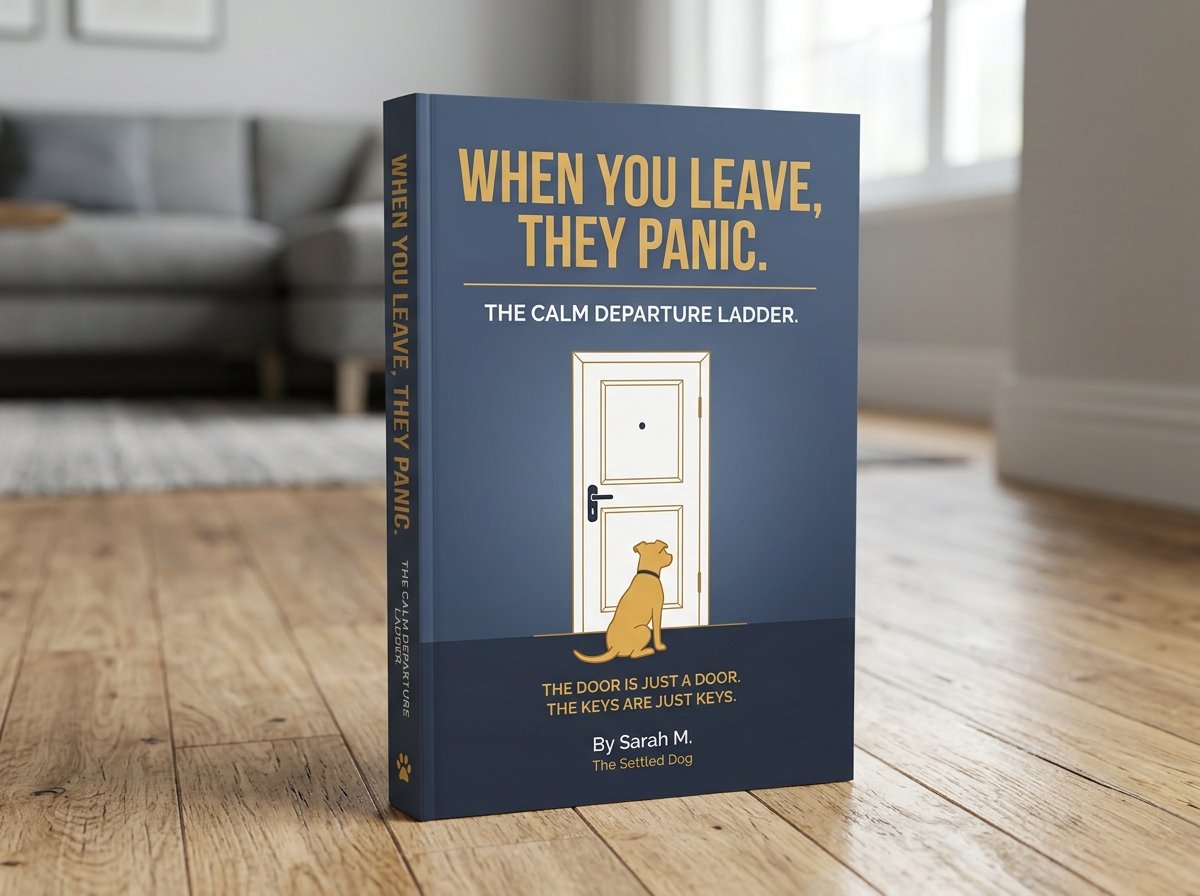
When You Leave, They Panic
The Calm Departure Ladder
The same protocol certified trainers charge $3,600 to implement. Structured so you can follow it yourself. Day by day. Step by step. Until the camera shows a sleeping dog.
What Other Owners Are Saying
The Complete Protocol: $120 value
Bonus #1 (The First Week Protocol): $30
Bonus #2 (Departure Cue Desensitization Checklist): $30
Total Value
$180
You Pay Today
$39
One payment. Lifetime access. The same protocol trainers charge $3,600 to implement. Day-by-day. Step-by-step.
Instant download • Both guides included • 30-day money-back guarantee
Plus: 2 Essential Guides
🐾 BONUS #1: The First Week Protocol
($30 Value. Yours FREE)
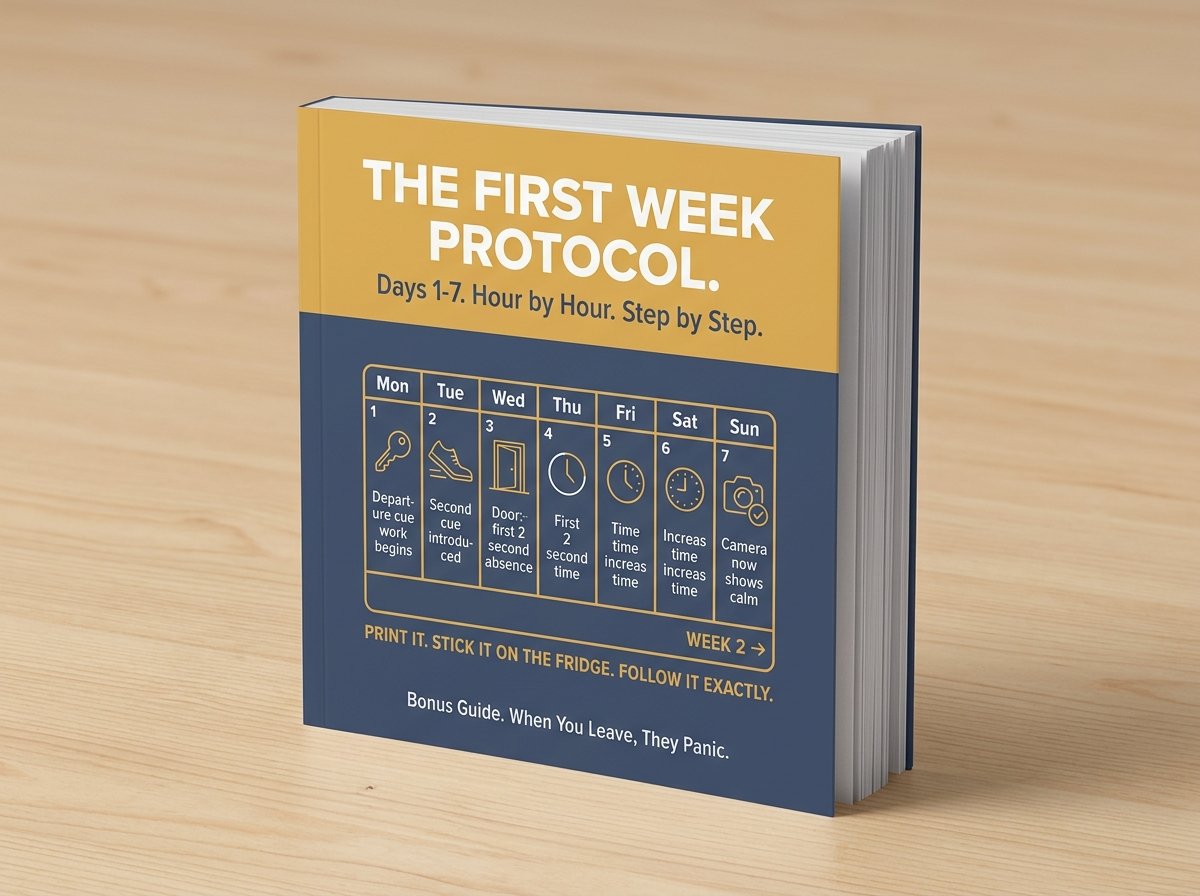
Days 1-7 mapped hour by hour. Exactly which departure cues to work on each day, how many repetitions, what to look for on the camera, and when to move to the next step. Print it. Stick it on the fridge. Follow it exactly. No decisions required. No guessing. Just do what Day 1 says, then Day 2, then Day 3.
🐾 BONUS #2: The Departure Cue Desensitization Checklist
($30 Value. Yours FREE)
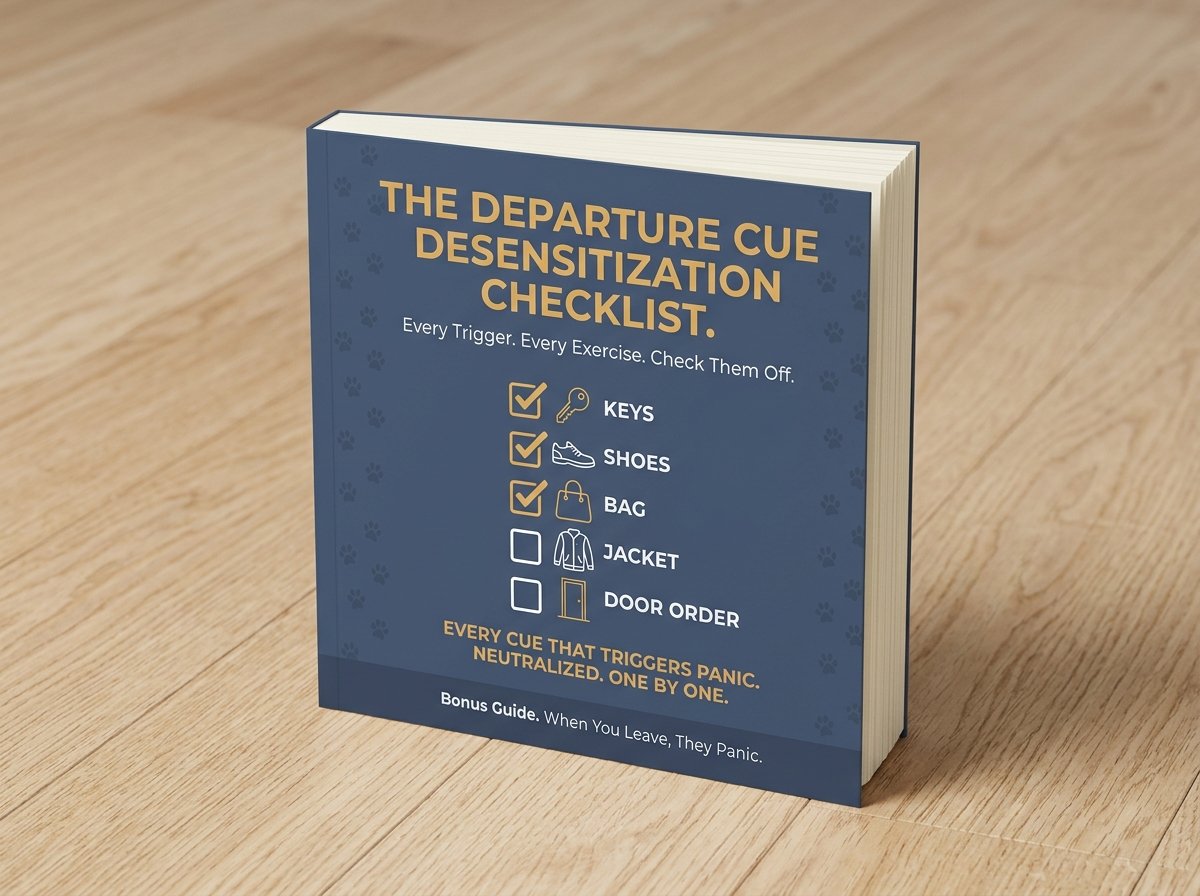
The complete list of departure cues your dog may be reacting to — and you don't know it. Keys, shoes, bag, jacket, wallet, sunglasses, the specific pocket you reach into, the order you do things, the room you go to last. Each cue has a specific desensitization exercise. Check off each one as it loses its power. Most owners find 4-6 cues they didn't know were triggers.
30-Day Money-Back Guarantee
Follow the protocol for 30 days. If your dog's separation anxiety doesn't improve, full refund. No questions asked.
You keep everything regardless.
Your dog either calms down or you pay nothing.
Right Now, You Have a Choice
Keep Managing the Panic
Another morning jingling the keys and watching the pacing start.
Another $30/day on daycare that sends him home overstimulated.
Another camera check at 10:30am showing 40 minutes of howling.
Another neighbor note. Another email from the apartment manager.
The panic doesn't resolve on its own. Every departure without desensitization reinforces the fear. Every day of untreated separation anxiety makes the association stronger. The doorframe damage doesn't stop. The neighbor patience doesn't last forever. And "just let him cry it out" makes it worse.
Teach Him the Door Is Safe
Imagine 4 weeks from now:
You pick up your keys. He doesn't move.
You close the door. Silence.
You check the camera from your desk. He's asleep on the couch.
The neighbor says: "Whatever you did, it worked."
$39. The same protocol certified trainers charge $3,600 to supervise. Day by day. Step by step. Below the panic threshold at every stage. The fear un-learns itself. The keys become just keys. The camera shows a sleeping dog.
P.S. #1: What will the camera show at 10:30am tomorrow? The same howling? The same doorframe? $39 and 4-6 weeks of daily practice stand between tomorrow's camera check and the one where your dog is asleep on the couch.
P.S. #2: You're spending $30/day on doggy daycare — that's $360+ per month to avoid the problem. The protocol costs $39 once and solves it. In one month of daycare savings alone, you've paid for the protocol 9 times over. The daycare manages the panic. The protocol ends it.
P.S. #3: The untouched Kong isn't your dog being stubborn. It's your dog being too scared to eat. A dog who can't eat when alone is a dog whose sympathetic nervous system is in full panic. That's not a training problem you can treat with peanut butter. That's a fear problem you treat with desensitization. The Calm Departure Ladder is desensitization. Structured. Day by day. Until the Kong gets eaten and the doorframe stays intact.