The calming diffuser didn't address the conditioned panic response. The chews couldn't supplement away a learned fear. The crate made it worse because containment amplifies panic in a dog who is already terrified. The Kong sat untouched because a panicking dog can't eat. "Letting him cry it out" deepened the association instead of breaking it. Everything you tried treated the anxiety without addressing the conditioning. You just chose the protocol that breaks the conditioning: systematic desensitization to departure cues, graduated absences below the panic threshold, and structured duration building. The same methodology certified trainers charge $3,600 to supervise. Yours to follow yourself. Day by day.
The door is about to become just a door. The keys are about to become just keys. The camera is about to show peace.
🐾 "My dog is not being bad. My dog is panicking. Panic is a conditioned emotional response, not a character flaw. The Calm Departure Ladder breaks the conditioning by changing the association: departure cues lose their predictive power, short absences build emotional resilience, and the panic threshold rises until my dog can handle 4-6 hours without distress. The protocol doesn't suppress the anxiety. It resolves it. Step by step. Below the panic threshold at every stage. Until the camera shows a sleeping dog."
Your Complete Protocol Is Ready
Click the button below to download the full protocol and both bonus guides instantly.
Download Your Guides Now🐾 Here's What You Got
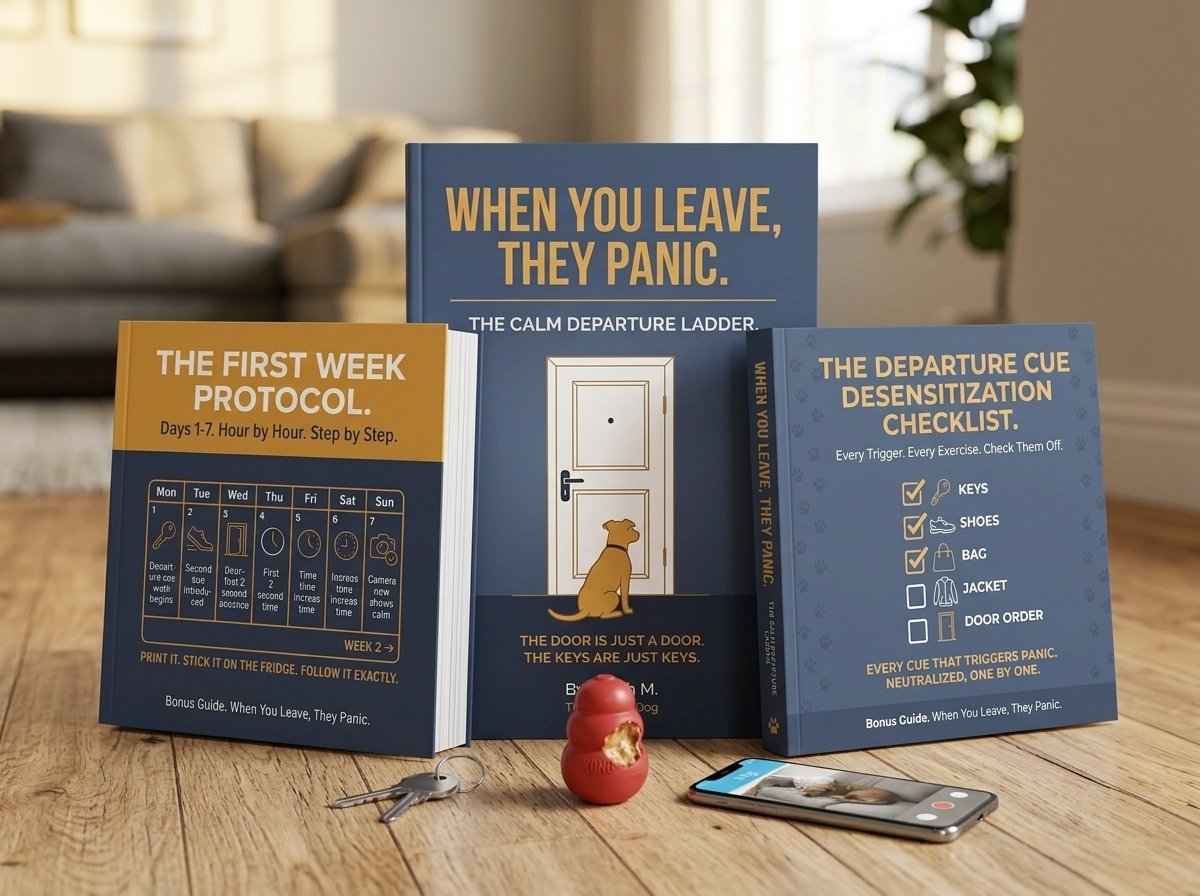
The complete 3-phase protocol: departure cue desensitization (neutralize keys, shoes, bag, jacket triggers), graduated absences (2 seconds to 2 hours, always below the panic threshold), and duration building (2 hours to 4-6 hours of calm alone time). Day-by-day structure. Camera check guidance. Setback protocol included
Days 1-7 mapped hour by hour. Exactly which departure cues to work on each day, how many repetitions, what to look for on the camera, and when to move to the next step. Print it. Stick it on the fridge. Follow it exactly
The complete list of departure cues your dog may be reacting to: keys, shoes, bag, jacket, wallet, sunglasses, the pocket you reach into, the order you do things, the room you go to last. Each cue has a specific exercise. Check them off as they lose their power
Your First 48 Hours
Download Everything Now
Tap the button above. Save all 3 files. You'll reference the main protocol and the First Week Protocol starting today.
Read the Departure Cue Checklist First (Bonus #2)
Open Bonus #2 and go through the full trigger list. Most owners know about keys and shoes. But the checklist includes 15-20 cues you may not realize your dog has associated with departure: the specific pocket you reach into for your keys, whether you go to the bathroom before leaving (your dog has noticed), the order you put things in your bag, even which room you walk to last. Identifying ALL the triggers before you start desensitizing them is critical. Miss one and it can re-trigger the cascade even after the others are neutralized.
Read the Main Protocol in Full
Read the complete Calm Departure Ladder before starting Day 1. Understanding WHY each phase works, WHY you start at 2 seconds (not 5 minutes), WHY you never push past the panic threshold, and WHY setbacks are normal and recoverable will keep you consistent when Day 4 feels tedious and Day 8 has a regression.
Print the First Week Protocol (Bonus #1)
Print it. Put it on the fridge or beside the front door. Day 1 starts tomorrow. Each day tells you exactly what to do: which cues, how many reps, what duration, what to watch for on the camera. No decisions. No improvising. Just follow Day 1, then Day 2, then Day 3.
Set Up Your Camera (If You Haven't Already)
You need to see what your dog does when you leave. A Ring camera, Wyze cam, Furbo, or any wifi camera pointed at the front door area works. The camera serves two purposes: (1) it tells you whether your dog is below the panic threshold during graduated absences, and (2) it shows you the progress that keeps you motivated. The day you check the camera and see a sleeping dog instead of a crying one is the day everything changes.
Plan Your Management Strategy for This Week
While the protocol is in progress, you still need to go to work. The protocol doesn't mean your dog can suddenly be alone for 8 hours tomorrow. During the training period, you need a management plan: daycare on office days, a dog walker for midday, a friend or neighbor who can sit with your dog, or working from home on training days. Page 22 of the main protocol covers management planning in detail. The goal: never expose your dog to a full-length absence that triggers panic while you're building the graduated tolerance. Every panic episode during training sets progress back.
🐾 What to Expect
⚡ Do This Right Now
Open the Departure Cue Checklist (Bonus #2) and do Exercise #1: The Key Test.
Stand up. Walk to where your keys are. Pick them up. Jingle them once. Put them back down. Sit on the couch. Watch your dog.
Did your dog's head lift? Did they stand up? Did they follow you? Did they start pacing?
Whatever your dog just did is the baseline. Write it down. This is where you're starting from. By Day 5, you'll do the same test and your dog won't move. The keys will have lost their power. That's Phase 1 working. That's the conditioning breaking.
"The keys are just keys. The shoes are just shoes. The door is just a door. Your dog will learn this. You're about to teach them."
🐾 30-Day Money-Back Guarantee
Follow the protocol for 30 days. If your dog's separation anxiety doesn't improve, full refund. No questions asked. You keep everything regardless.
Need Help?
Stuck on a step? Hit a setback? Not sure if you're reading the camera correctly? Email us. Dog owner to dog owner. We've been where you are.